Picture this: you find a crash gambling site, deposit $50, ride a few rounds, cash out at 4x – nice. Then you try to withdraw, and the support ticket just… sits there. Three days later, still nothing. You dig through the terms and find some buried clause about “manual review periods.” Ugh.
That’s the version of this hobby nobody advertises. The format itself – multiplier climbs, you bail before it crashes, repeat – is genuinely fun. Fast, skill-adjacent, weirdly social. But the platform underneath it? That’s where things get messy. A slick homepage and a fat welcome bonus can hide all kinds of problems. The real picture shows up at withdrawal time, or when a round ends suspiciously early, or when live chat is “temporarily unavailable” right when you need it.
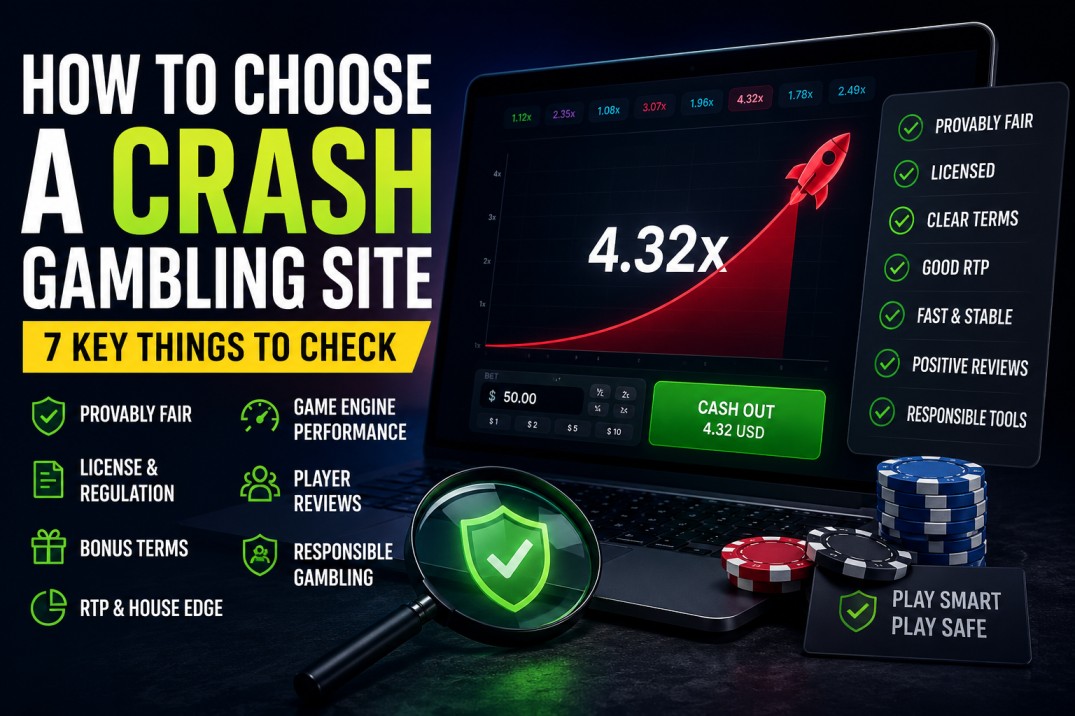
So, before you put real money anywhere, here are seven things that are actually worth checking.
Choosing a crash gambling site means looking past the welcome bonus and checking whether the platform is actually safe to use. The most important signs are real provably fair verification, an active license, clear bonus and withdrawal terms, transparent RTP, stable gameplay, recent player feedback, and responsible gambling tools. These checks help players avoid sites with slow payouts, hidden limits, weak support, or unreliable cashouts.
1. Provably Fair – Is It Real or Just a Badge?
Look, “provably fair” gets thrown around a lot. Most sites slap it somewhere in the footer like it’s a trust seal. But there’s a difference between a site that has provably fair and one where it actually works, and you can verify it yourself.
Here’s what legit looks like: before each round, the platform generates a server seed (hashed, so you can’t see it yet) and you submit a client seed. After the round, the server seed gets revealed – and you can run the hash yourself to confirm the outcome wasn’t changed mid-game. No guesswork. No “trust us.”
The best crash gambling platforms make this process dead simple, with a verification tool built right into the game interface. If a site offers no verification at all – or hides it three menu layers deep – that’s telling you something.
2. The License Isn’t Just Paperwork
Nobody enjoys reading regulatory footnotes. But that little license number in the footer is actually the difference between “I have recourse if something goes wrong” and “well, good luck with that.”
The three you’ll see most often: Curaçao eGaming, Malta Gaming Authority (MGA), and the UK Gambling Commission (UKGC). Curaçao is the easiest to get – it’s fast, cheap, and the oversight is… light. MGA and UKGC are more demanding. They require financial audits, player protection policies, and responsible gambling tools. If a site has one of those, it’s generally a better sign.
Whatever you see listed, verify it. Go to the regulator’s website, enter the license number, and confirm it’s active. Takes two minutes. A crash gambling site whose licensing is hard to verify is usually not worth the risk. Close the tab.
3. Bonus Terms – Read Before You Get Excited
A “200% welcome bonus up to $500” sounds incredible until you find the 40x wagering requirement buried on page three of the terms. On a high-volatility format like this, a 40x requirement isn’t a bonus – it’s a leash.
Before signing up anywhere, check:
- Wagering requirements – anything above 30x on a volatile game is worth side-eyeing.
- Withdrawal caps – some platforms limit how much you can pull per day, which turns a $2,000 win into a month-long drip.
- KYC timeline – legit sites require identity verification, but it should take days, not weeks.
- Crypto fees – some platforms quietly charge 2–5% on withdrawals. That adds up fast.
As Bettegi’s guide to casino bonus terms explains, the headline number is almost never the real story. The term doc is.
4. RTP – What the House Is Actually Taking
Every game has a built-in edge. That’s fine – it’s how casinos work. But there’s a massive difference between a 1% house edge and a 5% one, especially on fast-format games where you’re playing dozens of rounds per session.
The industry standard for this format is around 1–3%. Some platforms publish their RTP figures openly. Others don’t, which – make of that what you will.
If a site does publish RTP, cross-reference it against what players actually report on Reddit or Trustpilot. A platform advertising 99% RTP while players consistently describe losing streaks that don’t match the math? Something’s off. Numbers don’t lie, but marketing departments sometimes do.
5. The Engine Itself – Because Lag Costs Money
This sounds minor until it happens to you: you’ve got an auto-cashout set at 3x, the multiplier hits 3.01x, and… your cashout didn’t register. Round over. The platform shrugs and calls it a “connection issue.”
Not all game engines are built the same. On a crash gambling site, even a small delay can change whether a cashout lands or fails. Some are rock-solid – sub-100ms response times, smooth animations, reliable auto-cashout execution. Others are basically held together with duct tape. You can usually tell within the first few sessions which type you’re dealing with.
A few things worth testing before you go in deep:
- Auto-cashout accuracy – set a low multiplier and confirm it executes precisely, every time.
- Mobile stability – if it stutters on your phone, that’s a problem for a timing-sensitive format.
- Round speed – faster isn’t always better. Quick rounds compress variance, which can eat a bankroll faster than expected.
6. What Other Players Are Actually Saying
Marketing copy is useless for evaluating a platform. What’s not useless: players complaining on the internet, usually in great detail, with receipts.
Before depositing, spend 20 minutes here:
- Trustpilot – sort by recent, not overall score. A 4.1-star site with a wave of withdrawal complaints from the past two months is a red flag, full stop.
- Reddit (r/gambling, r/crashgambling) – unfiltered and often brutally honest.
- AskGamblers – specifically look at unresolved complaints. A platform that ignores them is showing you who they are.
Dr. Mark Griffiths, behavioral addiction researcher at Nottingham Trent University, has pointed out that player communities typically surface platform problems months before regulators do. Worth keeping in mind.
7. Responsible Gambling Tools – More Useful Than They Sound
Hear me out – this isn’t just an ethical checkbox. Platforms that invest in responsible gambling features tend to be operationally tighter across the board. It signals they’re building for long-term retention, not just short-term extraction.
What to look for:
- Deposit limits you can set yourself (daily, weekly, monthly)
- Session reminders – a nudge after 60 minutes is genuinely useful.
- Self-exclusion with a clear, working process
- Cool-down periods you can activate without calling support
As Bettegi’s overview of responsible gambling tools notes, there’s a real difference between operators who slap a “GamCare” logo on the footer and those who actually build these features into the experience. The latter group is generally safer to play on in every sense.
Final Thoughts
None of this is complicated – it just requires fifteen minutes of due diligence before you hand over your payment details. Check the license. Read the withdrawal terms. Spend a few minutes with recent player reviews.
The platforms worth playing on are transparent, responsive, and not actively working against you when you win. That’s a low bar, honestly. But in 2026, not every site clears it. The ones that do are worth finding – and keeping.
What should I check before choosing a crash gambling site?
Before choosing a crash gambling site, check whether the platform has real provably fair verification, an active license, clear bonus terms, transparent withdrawal rules, stable gameplay, published RTP details, recent player feedback, and responsible gambling tools.
Why does provably fair verification matter on crash gambling sites?
Provably fair verification matters because it lets players check that a crash game result was not changed after the round started.
A trustworthy site should make the verification process easy to find, simple to use, and clear enough for regular players to understand.
Is a gambling license enough to trust a site?
A gambling license is important, but it is not enough by itself.
Players should verify that the license is active and also review the site’s withdrawal rules, complaint history, support quality, and responsible gambling features.
What bonus terms are risky on a crash gambling site?
Risky bonus terms include very high wagering requirements, strict withdrawal caps, unclear KYC timelines, hidden crypto fees, and rules that make it difficult to cash out winnings.
The headline bonus amount is usually less important than the restrictions attached to it.
Why is game stability important in crash gambling?
Game stability matters because crash games depend heavily on timing.
Lag, mobile stutters, failed auto-cashouts, or slow response times can affect whether a cashout registers properly during a round.
Are player reviews useful when checking a crash gambling site?
Player reviews are useful when they are recent, specific, and show repeated patterns.
Look for complaints about delayed withdrawals, locked accounts, ignored support tickets, failed cashouts, or unresolved disputes instead of relying only on an overall star rating.