Ask most bettors how they evaluate their own performance, and they will point to their win rate. Ask a professional, and they will point to something else entirely: closing line value.
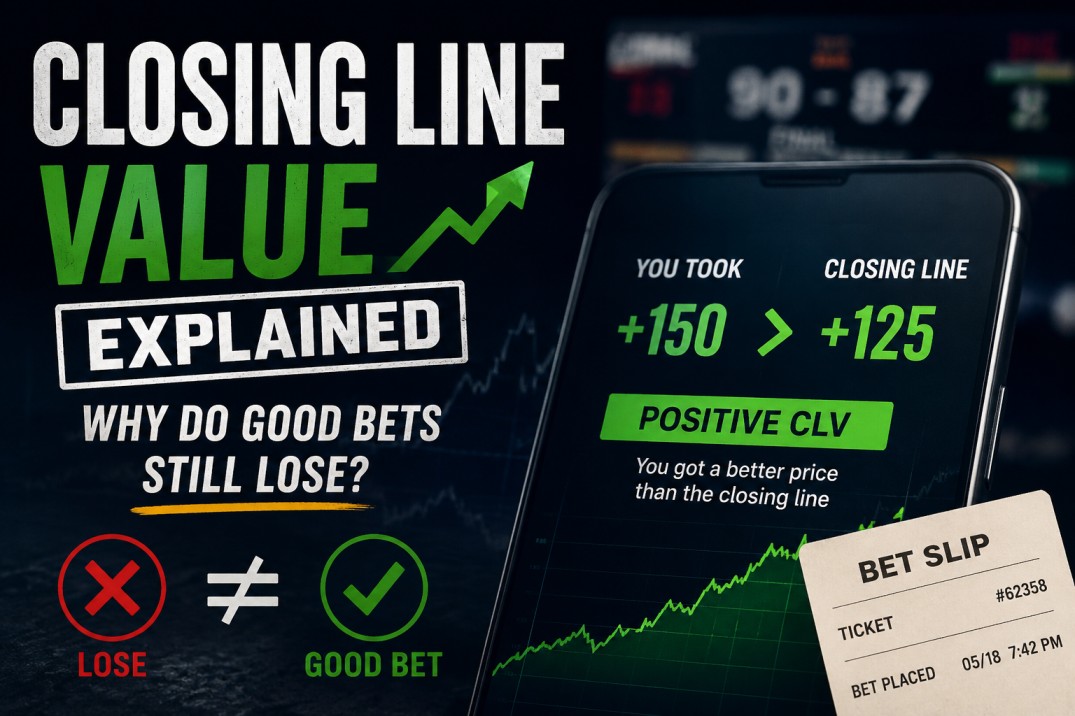
Closing line value — commonly abbreviated as CLV — is the difference between the odds you got when you placed a bet and the odds available on that same outcome at the moment the market closed, just before the event started. It sounds like a technical distinction. In practice, it is one of the most powerful diagnostic tools in sports betting, and understanding it will fundamentally change how you assess whether your approach is actually working.
Win rate tells you what happened. CLV tells you whether your process is sound. Those are very different things.
Closing line value, or CLV, measures whether the odds you took were better than the final market price before an event started. It matters because win rate only shows short-term results, while CLV shows whether your betting process is consistently finding value before the market adjusts. Positive CLV over a large sample suggests your picks are beating the market, while negative CLV usually means your edge is being lost through poor timing, weak prices, or bad process.
Why Win Rate Is Not Enough
Sports betting has a short-term variance problem. Even a bettor with a genuine long-term edge can lose consistently over hundreds of bets simply due to bad luck. Conversely, a bettor with no edge at all can run hot for months and believe they have found something real. Win rate, measured over any reasonable sample size that a recreational bettor accumulates in a season, is almost useless as a performance indicator.
CLV cuts through that noise. If you are consistently getting odds that are better than where the market closes, you are demonstrating that your assessments of probability are sharper than the collective market opinion at the time you bet. Over time, positive CLV is one of the strongest predictors of long-term profitability available. Negative CLV — consistently getting worse odds than the closing price — is a near-certain sign that your edge, if it exists at all, is being eaten by the margin before you even begin.
This is why serious bettors obsess over CLV while casual bettors obsess over their last winning accumulator.
How CLV Works in Practice
The mechanics are straightforward. Suppose you bet on a team to win at odds of 2.20 on Monday. By the time the game kicks off on Saturday, the closing odds on that team have moved to 1.80. You beat the closing line significantly — you got 2.20 on something the market eventually priced at 1.80. That is a strong positive CLV.
The reverse is equally instructive. If you bet at 2.20 and the line closes at 2.50, you got worse odds than the market ultimately settled on. The market moved away from your position, which suggests your bet was on the side that the majority of informed money was fading.
To track CLV accurately, you need two things: a record of the odds you took at the time of your bet, and a reliable source for closing odds. This is where platform choice becomes critical.
Pinnacle has long been the industry benchmark for closing line efficiency — their lines are widely considered the sharpest in the market and serve as the reference point for professional bettors globally.
For those who want access to the same sharp-facing model but need an agent-managed account structure with deeper Asian market liquidity, this Pinnacle Sports alternative operates on the same principle — accepting sharp action, keeping margins tight, and providing the kind of efficient closing lines that make CLV tracking genuinely meaningful.
Using a soft bookmaker as your CLV reference is almost pointless. Their lines are moved reactively and heavily influenced by public money rather than sharp positioning, which makes the closing price a poor measure of true market consensus.
What Consistent Positive CLV Looks Like Over Time
The relationship between CLV and profitability is not immediate — it plays out over large samples. A bettor who beats the closing line by an average of 2% across 500 bets has demonstrated a repeatable process. Whether they are up or down at any given point is almost irrelevant; the underlying edge is statistically measurable.
According to research consistently published by Pinnacle, beating the closing line is the closest thing to a verifiable edge that exists in sports betting. It is the metric their own traders use to identify sharp bettors — and the reason why sharp-facing books tend to limit or ban accounts that consistently show positive CLV, since those accounts are demonstrably extracting value from the market.
This creates a practical problem: if you are beating the closing line, the books that care about closing line efficiency will limit you. If you are not, the books that don’t care — the soft books that welcome recreational action — are offering you lines that are almost certainly priced against you to begin with. Understanding this dynamic is essential for any bettor who wants to operate with a long-term mindset.
How to Start Tracking Your CLV
Building a CLV tracking habit does not require complex software. A spreadsheet with consistent record-keeping is enough to start. For each bet, log the following:
- The selection and market — be specific enough that you can match it to a closing line later
- The odds you took — decimal format makes comparison arithmetic easier
- The time of your bet — early line value and closing line value are different things; context matters
- The closing odds — recorded from a sharp reference source after the market closes
- The CLV figure — calculated as (your odds / closing odds – 1) x 100, expressed as a percentage
After 100 bets, your average CLV will tell you more about your process than your profit and loss figure. After 500, it becomes statistically significant. At that point, you will have a genuine, data-backed answer to a question most bettors never honestly confront: do I actually have an edge?
CLV and Pattern Recognition: Two Sides of the Same Coin
CLV does not exist in isolation. As covered in Bettegi’s guide to pattern recognition in betting, the ability to identify value before bookmakers adjust their lines is exactly what CLV measures after the fact. Pattern recognition is the skill; CLV is the report card. Bettors who are genuinely good at spotting inefficiencies early — before the sharp money moves the line — will consistently show positive CLV. Those who follow public opinion or act on widely available information will show neutral or negative CLV, because by the time that information is priced in, the value is already gone.
The practical implication is that improving your CLV requires improving your information advantage — acting on better data, earlier, and with more precision than the market consensus. That is a high bar. But it is also the only bar that matters.
The Bottom Line
Most bettors evaluate themselves by outcomes. Professionals either in betting or betting exchange evaluate themselves by process. Closing line value is the bridge between those two approaches — a process metric that is objectively measurable, directly tied to long-term profitability, and almost completely ignored by casual bettors.
Start tracking it on your next bet. Be honest about what the data shows. If your CLV is consistently negative, the problem is not bad luck — it is bad process. And unlike luck, process can be fixed.
That is the difference between bettors who improve over time and bettors who simply accumulate losses while waiting for their luck to turn.
What is closing line value in sports betting?
Closing line value, or CLV, compares the odds you took when placing a bet with the final odds available before the event started.
If your odds are better than the closing price, you have positive CLV. If your odds are worse than the closing price, you have negative CLV.
Why is CLV more useful than win rate?
Win rate only tells you what happened after the bet settled, while CLV gives a clearer view of whether your betting process is finding value before the market adjusts.
A bettor can win in the short term without having an edge, or lose in the short term despite making strong value decisions. CLV helps separate process from variance.
Does positive closing line value guarantee profit?
Positive closing line value does not guarantee profit on every bet or over a short sample.
It is more useful as a long-term signal. Consistently beating the closing line over a large number of bets suggests that your process is stronger than simply judging results by wins and losses.
How do bettors track closing line value?
Bettors track CLV by recording the odds they took, the time of the bet, the market, and the closing odds from a reliable reference source.
Over time, comparing the entry price with the closing price can show whether the bettor is regularly getting better or worse prices than the final market.
Why does platform choice matter when measuring CLV?
Platform choice matters because not every bookmaker’s closing price reflects the same market quality.
Sharp, efficient markets usually provide a better reference point for CLV than soft books where prices may be shaped more by public money, wider margins, or liability management.