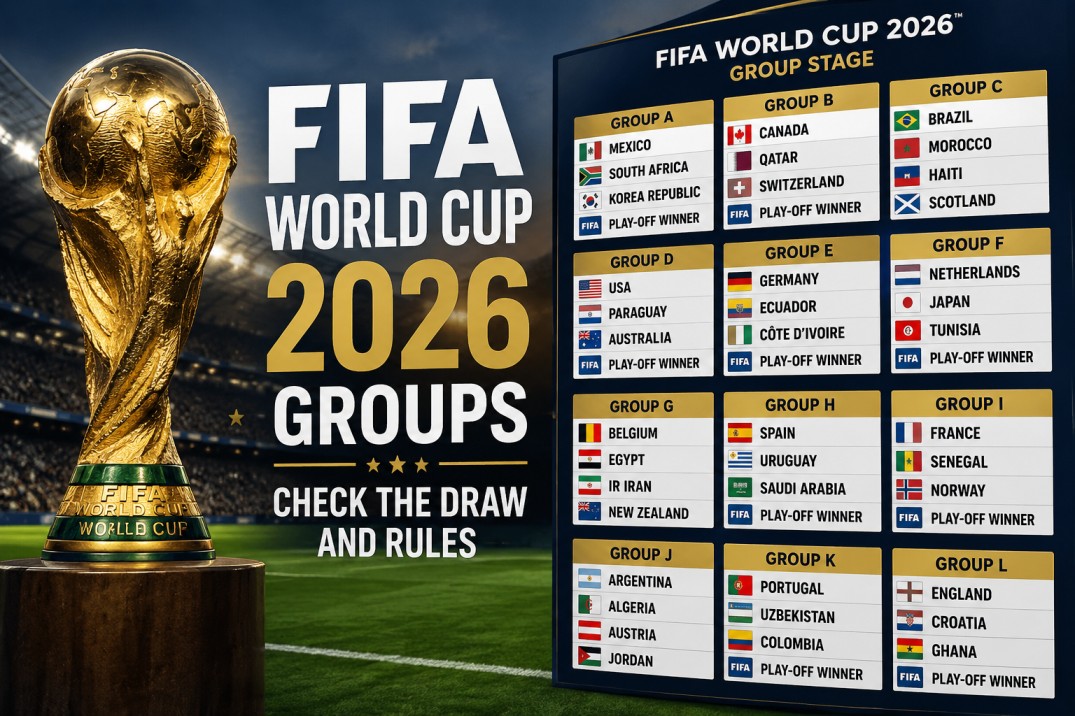
The FIFA World Cup 2026 groups will be the first real shock of the expanded tournament. Not because people cannot count to 48, but because the group stage will not feel like the one fans have watched for years.
There are more teams now, more ways to survive, and more room for chaos. A country that looks almost finished after two matches may still have a path. A team sitting third may spend the final night watching goal difference in another group. One late goal in an otherwise irrelevant match could suddenly change who reaches the round of 32.
That is what makes the 2026 format tricky.
Once the draw is made, most fans will look first at the biggest names in each group. That is natural, but it is not enough.
The harder part is reading the route: match order, travel, rest days, and whether a team can afford one bad result. That is where the 2026 groups get interesting.
The FIFA World Cup 2026 groups will feature 48 teams split into 12 groups of four. The top two teams from each group will advance automatically, along with the eight best third-placed teams. This expanded format makes group-stage results, goal difference, match order, and third-place standings more important for fans to follow.
FIFA World Cup 2026 Groups: How the New Format Works
For years, the World Cup group stage had a clean edge. Two teams went through. Two went home.
The 2026 tournament softens that line.
There will be 48 teams, arranged in 12 groups of four. FIFA’s official tournament format overview states that the top two in each group advance, along with the eight best third-placed teams.
That makes the table harder to read at a glance. Third place may be enough, but not always. A team on three points may still be alive. A team of four may still be nervous. A late goal in another group can change the order of the queue.
So the final group matches will not all follow the same script. Some teams will need to win. Some will need a point. Some will need goals. Others may spend the last few minutes trying not to lose badly.
That is where the 2026 format becomes interesting. It is not just about who is better on paper. It is about how each team handles the exact situation created by the table.
A 1-0 loss may not be a disaster. A heavy defeat could be. A late goal in another group may affect which third-placed teams advance. Fans will need to follow more than one table at a time.
The group stage is bigger now, but it is also more connected.
How Many Groups Are in the 2026 World Cup?
There are 12 FIFA World Cup 2026 groups, usually labeled Group A through Group L.
Each group contains four teams. That creates 48 total group-stage spots.
The group label is not just a letter next to a country’s name. It sets the early route: opponents, match order, travel rhythm, rest days, and the first possible knockout path.
A soft-looking group can become dangerous if the schedule is awkward. A tough-looking group can become manageable if a team starts quickly and avoids pressure in the final match.
That is why fans should not judge a group solely by its biggest name. The second, third, and fourth teams often decide how difficult the group really is.
A group with one elite nation and three balanced opponents can be more chaotic than a group with two clear favorites and two weaker sides. Balance creates pressure. Pressure creates mistakes.
How Teams Advance From the FIFA World Cup 2026 Groups
The qualification rule is simple on the surface.
The first-place team in each group advances.
The second-place team in each group advances.
The eight best third-placed teams also advance.
That gives the tournament 32 knockout teams.
The important part is the third-place comparison. Not every third-placed team goes through. Only eight of the 12 do. That means four third-placed teams are eliminated.
Because of that, goal difference and goals scored may become extremely important. A team that loses heavily in one match may damage its chances even if it later collects points.
For example, a third-placed team with four points and a healthy goal difference may be in a strong position. A third-placed team with three points and a poor goal difference may be in trouble.
Fans should look beyond wins and losses. In this format, a narrow defeat and a heavy defeat can lead to very different tournament paths.
In this format, a late goal in a match that already looks decided can still change the knockout picture.
FIFA World Cup 2026 Groups Example: How a Draw Could Look
Before using any sample group table, fans should check the official FIFA final draw results for confirmed groups, playoff placeholders, and any updates.
| Group Example | Team | Group Impact |
|---|---|---|
| Pot 1-style team | Argentina | A top seed usually enters the group as the clear favorite and sets the early standard. |
| Pot 2-style team | Japan | A strong second team can make the race for first place and automatic qualification much tighter. |
| Pot 3-style team | Morocco | A dangerous third team can turn a comfortable-looking group into a difficult one. |
| Pot 4-style team | New Zealand | A lower-ranked team can still affect goal difference, third-place math, and final matchday pressure. |
A favorable group can give a team room to grow into the tournament. A difficult group can force a strong team into survival mode immediately.
The draw changes more than the opponent list. It can give one team a smoother path to travel, another a short recovery window, and a third a brutal route into the knockout stage. It can also change ticket demand overnight, especially when a host nation or a major football country lands in a specific city.
This is especially important in a tournament spread across the United States, Canada, and Mexico. Travel and recovery may not be the same for every team. Some teams may have smoother routes. Others may deal with longer movement between matches.
The strongest teams usually expect to qualify, but the draw can still change how clean or difficult their route becomes. Winning the group can create a cleaner knockout path. Finishing second or third can send a team into a more dangerous bracket earlier than expected.
For smaller nations, the draw can define the tournament. One manageable matchup can create a realistic path to the round of 32. One brutal group can make every point feel like a major achievement.
What Makes a Group Difficult?
A difficult World Cup group is not always the one with the most famous team.
A group can become difficult for several reasons.
It may include one elite team and several physically strong opponents. It may contain two teams with high tournament experience. It may include a dangerous underdog that is hard to break down. It may have travel conditions that make recovery harder. It may create tactical problems because the teams play very different styles.
The most uncomfortable groups are often the ones without an obvious weak team.
When every match is competitive, favorites cannot relax. One draw can create pressure. One red card, injury, or defensive mistake can change the entire table.
That is why “group of death” talk can be misleading. Fans often look only at names. Coaches look at styles, schedule order, travel, and squad depth.
A group with famous teams may look dramatic. A group with four well-organized sides may be more dangerous.
What Fans Should Watch After the Draw
Once the FIFA World Cup 2026 groups are confirmed, fans should look beyond the headlines.
The first thing to check is match order.
A team that starts against the strongest opponent may face immediate pressure. A team that opens against the weakest opponent may have a chance to build confidence early. A team that faces a rotated favorite in the final match may benefit from timing.
The second thing to check is travel.
Some routes may be smoother than others. Shorter travel and more stable base planning can help teams recover, especially during a packed tournament.
The third thing to check is squad depth.
A 48-team World Cup with a round of 32 creates a longer path. Teams aiming to win the tournament may need to play eight matches. That makes rotation, bench quality, and injury management more important than ever.
The fourth thing to check is third-place math.
Some groups may produce several close matches. Others may create lopsided results. The third-place race could become one of the most interesting parts of the tournament.
Fans who understand this early will read the group stage better than people who only look at the standings.
Why Third-Place Teams Change the Tournament
The eight best third-placed teams make the 2026 World Cup more forgiving, but also more complicated.
A team can qualify without being one of the top two in its group. That keeps more nations alive. It also means the final group-stage matches may feel strange, as some teams may be trying to protect their goal difference rather than chasing a wild win.
For neutral fans, that should create a better group stage. More teams stay alive, more games carry knockout consequences, and more late goals can change the round-of-32 picture.
For coaches, it creates difficult decisions.
Should a team chase a winner and risk losing by more? Should it protect a draw and hope the third-place table is enough? Should it rotate players if qualification is likely but not certain?
These are not simple choices.
The third-place system rewards teams that stay disciplined. A team that avoids heavy defeats may survive even without dominating its group. A team that collapses once may pay for it later.
In 2026, damage control can be part of tournament strategy.
How the Groups Can Affect Ticket Demand
The FIFA World Cup 2026 groups will also affect ticket demand.
Before the draw, many fans may buy based on city, date, or stadium. After the draw, demand can shift quickly once supporters know where specific teams will play.
A match involving a host nation or a major football country can become much more attractive. A game that looked quiet before the draw may suddenly become one of the most wanted tickets in that city.
This is why fans following the ticket market should pay attention to the groups. The draw does not only affect the football. It affects travel plans, hotel demand, resale interest, and matchday atmosphere.
For fans who already have tickets, the draw can turn a normal match into a special one. For fans still waiting to buy, it can make the market more stressful.
The group announcement is one of the moments where tournament planning becomes real.
FIFA World Cup 2026 Groups and Betting Interest
The group stage usually attracts a lot of betting interest because there are many matches, many team styles, and many narratives.
But the 2026 format requires extra caution.
A favorite may not need to win its final group match if qualification is already secure. A third-placed team may play differently if a draw is enough. A team with a poor goal difference may need to attack even when the matchup looks unfavorable.
That means group-stage betting should not be based only on team reputation.
The final group matches can become awkward in this format. One team may already be safe and rotate players. Another may need only a draw. A third may have to chase goals because its goal difference is not big enough. By that point, the table will tell a much better story than reputation.
For readers, the safest mindset is to treat the group stage as a situation-based market rather than just a team-strength market.
A big name does not always equal value. A desperate team is not always a smart bet. A rotated lineup can change everything.
Which Groups Should Fans Watch Closely?
The most interesting FIFA World Cup 2026 groups will be those with balance, not just those with famous teams.
A group with one clear favorite and three teams fighting for second and third can be dramatic. A group with two strong teams and a dangerous underdog can create early pressure. A group where every team has a realistic path can produce the most tension.
Fans should especially watch groups where:
The favorite has a difficult travel schedule.
The second and third teams are close in quality.
A debut nation faces an experienced tournament side.
A host nation carries heavy pressure.
The final matchday could decide multiple qualification spots.
The best group-stage stories often come from uncertainty.
Nobody remembers a predictable group where the favorites cruise through. People remember the group where one late goal changes everything.
What Happens After the Group Stage?
After the group stage, the 2026 World Cup moves into a round of 32.
This is another major change. In the old format, the tournament jumped from 32 teams to a round of 16. In 2026, twice as many teams will enter the first knockout round.
That makes finishing position important.
A group winner may get a better route. A runner-up may face a harder path. A third-placed qualifier may survive the group but land in a very difficult knockout matchup.
For teams with title ambitions, the group stage is not only about survival. It is about controlling the route.
For underdogs, reaching the round of 32 may already be a huge achievement. Once they get there, one good performance can change the tournament.
This is part of what makes the expanded format interesting. More teams get a knockout chance. More nations get a moment. More matches carry real consequences.
Final Thoughts
The FIFA World Cup 2026 groups will shape the entire tournament. With 48 teams, 12 groups of four, and eight third-placed teams advancing, the group stage is bigger and more layered than before.
Fans should not look only at the biggest names. The real story will come from match order, travel, team depth, goal difference, third-place calculations, and how each team handles pressure.
A group that looks simple on paper can become messy after one upset. A difficult group can open up if a favorite rotates or starts slowly. A third-placed team can survive if it manages damage and takes its chances at the right time.
That is why the 2026 group stage deserves more attention than a quick glance at the draw.
It will not just decide who advances. It will shape ticket demand, knockout routes, team strategy, and the rhythm of the entire World Cup.
How many FIFA World Cup 2026 groups are there?
The FIFA World Cup 2026 groups will include 12 groups of four teams, making room for 48 teams in the expanded tournament.
Each team plays three group-stage matches before the tournament moves into the knockout rounds.
How do teams advance from the FIFA World Cup 2026 groups?
The top two teams from each group advance automatically to the knockout stage.
The eight best third-placed teams also qualify, which means goal difference, goals scored, and final group results can become very important.
Are the FIFA World Cup 2026 groups official yet?
Fans should always check FIFA’s official draw results for the confirmed groups, because placeholders, playoff spots, and qualification updates can change the full picture.
Any example group draw should be treated only as a sample scenario until FIFA confirms the official groups.
Why are third-placed teams important in the 2026 World Cup?
Third-placed teams matter because eight of the 12 third-place finishers will still reach the knockout stage.
This makes every goal important, even in matches where a team cannot finish first or second in its group.
What should fans watch after the FIFA World Cup 2026 draw?
Fans should look at match order, travel demands, squad depth, goal difference risks, and how balanced each group looks.
A group can look simple on paper but become difficult if the schedule, styles, or third-place race create pressure.