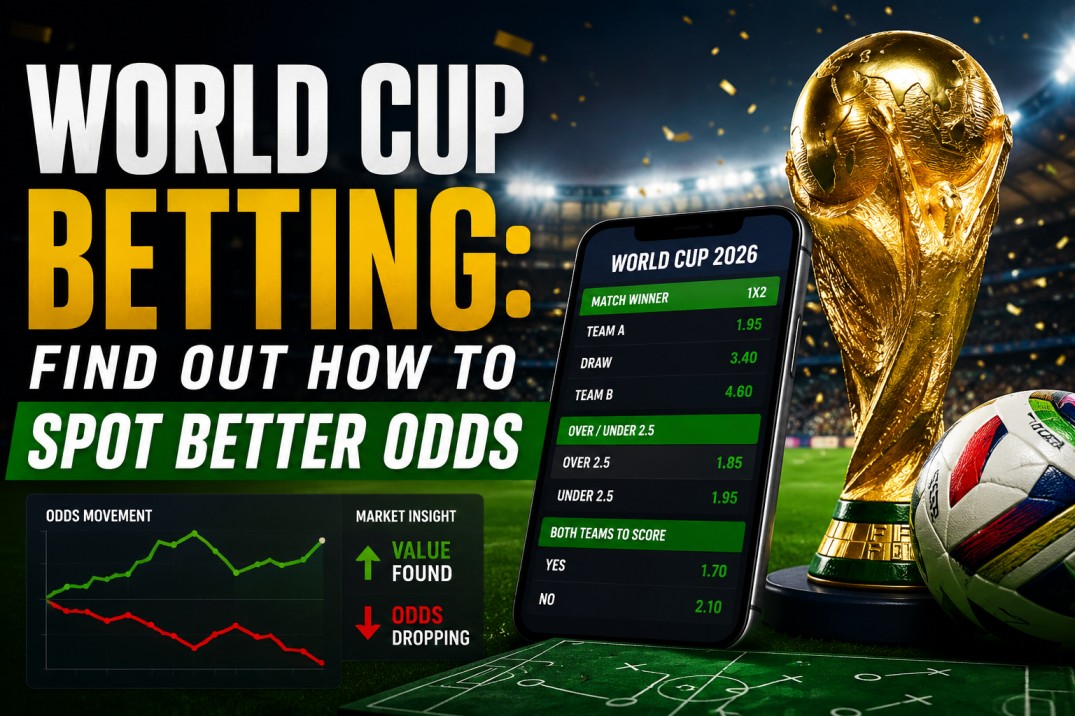
World Cup betting is not only about picking the team you think will lift the trophy. In 2026, it also means reading a bigger tournament, more matches, more props, more live markets, more prediction markets, and more casual bettors entering the market at the same time.
That is where things get interesting.
A normal league season gives you form, rhythm, injuries, travel patterns, and recent team habits. The World Cup gives you short windows, emotional games, rotated squads, unfamiliar opponents, and markets that can overreact after one loud result.
So yes, favorites matter.
However, in World Cup betting, the favorite is only one part of the story. The draw, the group path, rest days, travel, squad depth, penalty takers, and knockout route can change the value of a bet before the team even plays.
FIFA says the 2026 World Cup is the first edition with 48 teams, three host countries, and 104 fixtures. That makes this tournament bigger than any previous World Cup, and it also makes the betting board messier.
Bigger can mean more opportunity. It can also mean more traps.
World Cup betting covers soccer wagers tied to the FIFA World Cup, including match odds, futures, group markets, props, live betting, and prediction markets. The 2026 tournament changes the betting landscape because it expands to 48 teams, 104 matches, three host countries, and a larger U.S. betting audience. Smart bettors compare favorites, schedules, group paths, player usage, and market movement before treating any World Cup pick as obvious.
What Is World Cup Betting?
World Cup betting means placing wagers on markets connected to the FIFA World Cup.
That can include match winners, group winners, outright champion odds, top goalscorer, team totals, player props, cards, corners, live betting, stage of elimination, and prediction market contracts.
Some bets settle after 90 minutes plus stoppage time.
Others depend on who advances, who scores across the tournament, or which team wins the final after extra time and penalties. That difference matters because many casual bettors misunderstand how soccer markets settle.
For example, a three-way moneyline usually includes home win, draw, and away win.
In a knockout match, a team can win the tie after penalties, while your 90-minute moneyline bet still loses or pushes nowhere because the regulation result was a draw.
That is the kind of detail that separates a real betting guide from a list of random picks.
Why the 2026 World Cup Betting Market Is Different
The 2026 World Cup is not just another tournament with a fresh logo.
It is larger, longer, and spread across the United States, Canada, and Mexico. More teams means more group-stage combinations, more betting markets, and more public money chasing teams people barely watched during qualifying.
That creates two problems.
First, sportsbooks will offer more markets than most bettors can properly price.
Second, casual money can move odds in strange ways, especially around famous teams, star players, and host nations.
CBS News reported a forecast that Americans could wager $3.1 billion on World Cup games through online sports betting, with prediction markets projected for another $2.4 billion.
That is a serious amount of attention.
When a market gets that much public traffic, prices can become less about pure probability and more about attention, emotion, and brand names.
FIFA confirms the 2026 World Cup is the first edition with 48 teams.
The expanded tournament includes 104 fixtures across the competition.
The tournament is hosted across the United States, Canada, and Mexico.
CBS News reported a forecast for U.S. online sports betting on World Cup games.
According to FIFA, the 2026 tournament is the first World Cup with 48 teams and 104 fixtures, a major jump from the previous 32-team, 64-match format. That bigger schedule creates more group-stage prices, more live betting windows, more player props, and more chances for the market to misread motivation, rotation, and matchup pressure. For bettors, the official 2026 tournament format is not just background information; it is one of the first things to check before comparing odds.
World Cup 2026 Results So Far
The early 2026 World Cup results have already made one thing clear: this tournament is not behaving like a clean favorites-only betting board.
| Date | Group | RESULT | Betting Read |
|---|---|---|---|
| June 11 | A | Mexico2 – 0South Africa |
Mexico opened with control and immediately looked like the cleanest Group A favorite. |
| June 12 | A | South Korea2 – 1Czechia |
South Korea’s win gave it early second-place value before the Mexico match. |
| June 12 | B | Canada1 – 1Bosnia and Herzegovina |
Canada dropped early points, but the result kept Group B wide open. |
| June 13 | D | United States4 – 1Paraguay |
The United States made one of the strongest early statements of the tournament. |
| June 13 | B | Qatar1 – 1Switzerland |
Switzerland missed a chance to separate early, which made goal difference more important. |
| June 14 | C | Brazil1 – 1Morocco |
Brazil avoided damage, but Morocco proved it could compete for the group. |
| June 14 | C | Haiti0 – 1Scotland |
Scotland picked up a valuable three points in a tight group-stage race. |
| June 14 | D | Australia2 – 0Turkey |
Australia gave itself a strong second-place route before facing the United States. |
| June 14 | E | Germany7 – 1Curacao |
Germany’s huge win created a major goal-difference cushion. |
| June 14 | F | Netherlands2 – 2Japan |
Japan showed real strength and made Group F much less predictable. |
| June 15 | E | Ivory Coast1 – 0Ecuador |
Ivory Coast took a key step toward second place behind Germany. |
| June 15 | F | Sweden5 – 1Tunisia |
Sweden’s big win kept it alive as one of the stronger third-place candidates. |
| June 15 | H | Spain0 – 0Cape Verde |
Spain’s flat opener warned bettors not to treat favorites as automatic covers. |
| June 15 | G | Belgium1 – 1Egypt |
Egypt got a useful point and Belgium left pressure on itself for later matches. |
| June 16 | H | Saudi Arabia1 – 1Uruguay |
Uruguay missed a chance to take early control of second place. |
| June 16 | G | Iran2 – 2New Zealand |
Iran stayed unbeaten, but the draw kept Group G messy. |
| June 16 | I | France3 – 1Senegal |
France looked strong early and put Senegal under pressure immediately. |
| June 17 | I | Iraq1 – 4Norway |
Norway’s attack changed the group winner and goal-difference conversation. |
| June 17 | J | Argentina3 – 0Algeria |
Argentina opened cleanly and protected both points and goal difference. |
| June 17 | J | Austria3 – 1Jordan |
Austria stayed level with Argentina on points after Matchday 1. |
| June 17 | K | Portugal1 – 1DR Congo |
Portugal’s draw created early value questions around Group K. |
| June 17 | L | England4 – 2Croatia |
England’s attack impressed, but Croatia still showed enough threat to stay relevant. |
| June 18 | L | Ghana1 – 0Panama |
Ghana’s narrow win made the race for second place more interesting. |
| June 18 | K | Uzbekistan1 – 3Colombia |
Colombia took early control while Portugal still had work to do. |
| June 18 | A | Czechia1 – 1South Africa |
The draw hurt both teams and strengthened South Korea’s second-place outlook. |
| June 18 | B | Switzerland4 – 1Bosnia and Herzegovina |
Switzerland made a major goal-difference move after its opening draw. |
| June 19 | B | Canada6 – 0Qatar |
Canada’s blowout win flipped the group picture and boosted its goal difference. |
| June 19 | A | Mexico1 – 0South Korea |
Mexico became the clear Group A leader after beating its main rival. |
| June 19 | D | United States2 – 0Australia |
The United States moved close to locking the group with another controlled win. |
| June 20 | C | Scotland0 – 1Morocco |
Morocco’s win put it in a strong position beside Brazil. |
| June 20 | C | Brazil3 – 0Haiti |
Brazil recovered from the opening draw and added a useful goal-difference boost. |
| June 20 | D | Turkey0 – 1Paraguay |
Paraguay stayed alive and turned the Australia match into a key qualification fight. |
| June 20 | F | Netherlands5 – 1Sweden |
The Netherlands answered doubts with a statement win over Sweden. |
| June 20 | E | Germany2 – 1Ivory Coast |
Germany won again, but the tighter score showed why one blowout does not tell the whole story. |
| June 21 | E | Ecuador0 – 0Curacao |
This result helped Ivory Coast more than either team on the pitch. |
| June 21 | F | Tunisia0 – 4Japan |
Japan’s big win kept it level with the Netherlands on points and goal difference pressure. |
| June 21 | H | Spain4 – 0Saudi Arabia |
Spain responded strongly after its opening draw and took control of Group H. |
| June 21 | G | Belgium0 – 0Iran |
Belgium remained winless, while Iran stayed alive through another draw. |
| June 22 | H | Uruguay2 – 2Cape Verde |
Cape Verde kept the group uncomfortable, while Uruguay still lacked a win. |
| June 22 | G | New Zealand1 – 3Egypt |
Egypt became the clearest team in Group G after Belgium and Iran both stalled. |
Mexico opened Group A with a controlled 2-0 win over South Africa and then beat South Korea 1-0, while the United States made an even louder start by beating Paraguay 4-1 and Australia 2-0.
Germany also gave bettors a big early signal with a 7-1 win over Curacao, but even that result needs context, as the next match against the Ivory Coast was much tighter, 2-1. That is exactly why World Cup betting can punish people who react only to a single scoreline rather than reading the full group picture.
Some favorites have already looked strong, but others have left warning signs. Brazil drew 1-1 with Morocco before beating Haiti 3-0, Spain opened with a flat 0-0 against Cape Verde before responding with a 4-0 win over Saudi Arabia, and Portugal started with a 1-1 draw against DR Congo.
Those results matter because group-stage betting is rarely about one match in isolation. A team can still top the group after a slow start, but its price may move sharply before the real value disappears.
The most interesting betting spots so far may be the groups where the second and third teams are still alive. Japan’s 4-0 win over Tunisia, Sweden’s 5-1 win over Tunisia, Morocco’s 1-0 win over Scotland, and Egypt’s 3-1 win over New Zealand all changed the shape of their groups quickly.
For live betting and futures, the lesson is simple. Do not just ask who won; ask how the win changes motivation, goal difference, rotation risk, and the price before the next match.
Through the completed matches so far, 26 of 40 games have finished with 2 to 5 total goals. That makes the 2-5 goals range worth tracking before betting totals, live markets, or safer goal-based picks.
World Cup Betting Favorites Are Not Free Money
Every World Cup has a familiar pattern.
People look at Brazil, France, Argentina, England, Spain, Germany, Portugal, or another big name and assume the safer side is obvious. Then the match starts, the underdog sits deep, the favorite struggles to break the block, and suddenly a “simple” bet looks uncomfortable.
That is why world cup betting favorites need a colder read.
A favorite can be the better team and still be overpriced.
The World Cup creates short matches with huge pressure. One early mistake, one red card, one penalty, one bad pitch, or one rotated lineup can ruin a price that looked safe on paper.
The public usually loves famous shirts.
Sportsbooks know that. Therefore, the number you see may already include extra public demand.
So, instead of asking, “Who is better?” ask something sharper.
Is the price still fair after the market already punished the underdog?
World Cup Betting Trends for 2026
The first big trend is volume.
With 104 matches, bettors get more entry points than before. That means more group-stage markets, more live betting windows, more player props, and more futures prices moving after every result.
The second trend is prediction markets.
These markets do not always look like traditional sportsbook bets. Instead, they often trade like event contracts where prices move as buyers and sellers react to probability.
That can attract people who do not think of themselves as sportsbook bettors.
The third trend is micro-reading.
Bettors will not only look at who wins. They will look at cards, corners, shots, player minutes, first-half pace, goalkeeper saves, and live odds after tactical changes.
However, that does not mean every small market is worth touching.
More markets can mean more edge, but they can also mean more ways to bet on things you do not understand.
A Practical World Cup Betting Workflow
Before you place a World Cup bet, slow the process down.
You do not need a complicated spreadsheet, but you do need a repeatable check.
Know whether the bet settles after 90 minutes, qualification, group finish, or tournament outcome.
Look at rest days, travel, rotation risk, and whether one team needs a result more than the other.
Ask whether the odds are fair or just inflated by public money on a famous team.
If the number is ugly, skip it or look for a better live angle after the match begins.
FIFA World Cup Betting Markets to Watch
The biggest mistake is thinking every market works the same way.
They do not.
Outright winner betting is slow and narrative-heavy. Match betting is sharper and more immediate. Group winner markets depend on schedule order, goal difference, and how teams approach the third match.
Player props depend on minutes.
That sounds obvious until a star forward gets rested in Matchday 3 because his team already qualified. Suddenly, a top scorer ticket or shots prop is not about talent anymore.
It is about usage.
Here are the markets bettors usually watch first.
| Market | What It Really Tests | Common Trap |
|---|---|---|
| Outright Winner | Squad depth, route, coaching, health, and knockout pressure | Backing a famous team after the price is already too short |
| Group Winner | Schedule order, goal difference, rotation, and matchup balance | Ignoring who plays the weakest team first or last |
| Match Winner | 90-minute quality, tactics, and game state | Forgetting the draw is a live option in soccer betting |
| Top Goalscorer | Minutes, penalties, team path, and shot volume | Picking a star whose team may exit early |
| Live Betting | Tempo, substitutions, red cards, and tactical changes | Chasing odds after a goal without reading the match |
Why Group Winner Bets Deserve More Attention
Group winner betting can be smarter than picking the tournament champion.
Why?
Because you are pricing three matches instead of seven. You still need to understand the teams, but the path is shorter and the variables are easier to map.
However, group betting is not simple.
The order of matches matters. A favorite that plays the toughest opponent first may approach the group differently from a favorite that starts against the weakest side.
Goal difference also matters.
If two teams are likely to finish close, the team with a better chance of beating a weaker opponent by multiple goals may carry extra value.
So, when you read group markets, do not only rank teams.
Read the schedule.
Live Betting Can Be Better Than Pre-Match Betting
Some World Cup matches do not reveal themselves until kickoff.
A team may press higher than expected. A favorite may look nervous. An underdog may defend well enough to kill the rhythm. A referee may call the match tightly, which changes cards and penalty risk.
That is why live betting can be useful.
However, live betting is dangerous when you are emotional.
If you are only reacting to the scoreboard, you are probably late. The market already adjusted.
Instead, watch how the match is being played.
Is the favorite creating real chances or only holding the ball? Is the underdog defending comfortably or surviving panic? Are substitutions likely to improve the attack or protect the draw?
Those questions matter more than possession alone.
Before betting a World Cup favorite, check whether the price reflects team strength or public excitement. If the number already feels expensive, wait for a better market.
Real Life Sample: The Heavy Favorite Problem
Imagine a top-ranked team opens against a smaller nation.
The favorite has elite players, a famous coach, and a huge public following. The odds are short, social media is loud, and most casual bettors see no reason to overthink it.
Then the match begins.
The underdog sits in a low block. The favorite takes twenty minutes to find rhythm. The referee lets contact go. The underdog goalkeeper makes two big saves.
Now the favorite may still win, but the pre-match price was ugly.
A better bettor might wait for live odds, look at team total goals, or skip the match entirely.
That is not cowardice.
That is price discipline.
Real Life Sample: The Group Stage Motivation Trap
Now imagine a strong team wins its first two group matches.
By the third match, it may already be qualified. The coach may rest starters, protect players on yellow cards, and avoid injuries before the knockout round.
The opponent, meanwhile, needs a result to survive.
A casual bettor sees the stronger name and bets it.
A sharper bettor asks whether the stronger team actually needs the match.
That difference is huge in world cup betting because group-stage motivation can change quickly.
Prediction Markets vs Sportsbooks
Prediction markets are now part of the conversation.
They can look similar to betting because users buy and sell positions tied to outcomes. However, the pricing, fees, rules, liquidity, and regulatory structure may differ from a sportsbook.
That matters for World Cup betting because prices can vary across platforms.
A sportsbook may offer odds on match winners, props, and futures. A prediction market may offer event-style contracts on who advances, wins a group, reaches a round, or wins the tournament.
The practical takeaway is simple.
Do not assume every price means the same thing. Check the rules, settlement terms, fees, and liquidity before comparing markets.
Common Mistakes in World Cup Betting
The first mistake is betting on a team because of its name.
Big countries lose, draw, rotate, and underperform.
The second mistake is ignoring the draw.
Soccer is not basketball. A stronger team can dominate and still finish 1-1.
The third mistake is mixing up qualification and 90-minute markets.
A team advancing after penalties is not the same as winning in regulation.
The fourth mistake is betting props without checking expected minutes.
A forward cannot cash a shot line from the bench.
The fifth mistake is chasing after one match.
Tournament markets overreact because every game feels huge.
A Smarter Way to Read World Cup Betting Favorites
If you like a favorite, ask five questions.
Is the lineup likely to be full strength?
Does the team need a win, or is a draw enough?
Is the opponent built to frustrate better teams?
Is the price shorter because the team is popular?
Is there a better angle than the moneyline?
Sometimes the answer is yes, the favorite is still playable.
But often, the better bet is a team total, group market, live entry, or no bet at all.
No bet is not boring.
It is part of surviving a long tournament.
Final Thoughts
The 2026 World Cup will bring a huge betting board.
That does not mean every market deserves your money.
The smarter approach is to treat world cup betting like tournament reading, not just team picking. You are reading schedule, motivation, format, odds, injuries, public money, and market rules.
Favorites will attract attention.
Props will look tempting.
Live odds will move fast.
Prediction markets will add another layer.
Still, the same rule holds: do not bet the badge, bet the price.
If the number is bad, wait.
If the market is unclear, skip it.
And if the bet only makes sense because everyone else is excited, that is usually the exact moment to slow down.
What does World Cup betting mean?
World Cup betting means placing wagers on FIFA World Cup markets such as match winners, group winners, outright champions, player props, live odds, and tournament futures. The key is knowing how each market settles before you place a bet.
How can you spot better odds in World Cup betting?
Better odds usually appear when the market overreacts to famous teams, recent results, injuries, or public betting pressure. You can spot value by comparing the price with team form, schedule difficulty, motivation, lineup news, and the exact betting rules.
Are World Cup favorites always safe bets?
No, World Cup favorites are not always safe bets. A favorite can be the stronger team and still be overpriced because public bettors often back big names, star players, and popular countries without checking the real value of the odds.
What are the most important World Cup betting markets?
The most important markets include match winner, outright winner, group winner, team to qualify, top goalscorer, player props, cards, corners, and live betting. Each market has different rules, so bettors should check settlement terms before betting.
Is live betting useful during the World Cup?
Live betting can be useful because World Cup matches often change quickly after team tactics, substitutions, red cards, or early goals. However, live betting works best when you read the match itself, not only the scoreboard.